
'I left the Congress because everybody is busy in attending to their individual vested interests,' says former Union minister Krishna Tirath, who joined the BJP on Monday.

For a rising country like China with its sights set on global and regional power, any coming together of the US and India is the worst case scenario. Hence, China is concerned with the emerging equations between New Delhi and Washington, says Srikanth Kondapalli.

The government must justify why we need to buy foreign reactors when we have developed up to 700 MWe unit-size pressurised heavy water reactors, a design which can be easily extended to 900 to 1000 MWe unit size. Why can't the 'Make in India' philosophy apply to indigenous nuclear reactors, more than 18 of which have been designed, built, and being operated by Indian engineers, asks Dr A Gopalakrishnan.

The new ordinance on land acquisition will allow land grabbers to deprive millions, destroy agriculture, horticulture, rivers, forests, tree cover and mangroves to extract minerals as well as ground water, without replenishment at a pace that will not leave anything for the next generation, warns activist Medha Patkar.

'I've seen the craze for English education even among the poorest. But that is only for their sons. Parents feel thrilled when they see their sons going to school wearing a tie. They don't mind paying for their sons' private tuitions too.' 'But daughters are sent to municipal schools, madarsas, small schools where teachers with no teaching skills are paid Rs 2,000 or Rs 4,000. That's why more girls come to my class.' Syed Feroze Ashraf, who has sent 500-odd girls (and a few boys) -- all first generation learners, children of grave-diggers, hawkers, rickshaw-drivers, tailors and watchmen -- to college, speaks to Jyoti Punwani. A Rediff.com Special.

Often when I meet a new Indian friend, who is not aware of my background, he exclaims: "So many years in India! but why, why? I can't understand! My dream is to go to the States or Europe and you are living in 'this' country!" Claude Arpi, who was born a Frenchman, looks back on his 40 years in India.
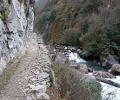
'It is certainly time for New Delhi to open up. Not only should it go ahead at full steam with the roads to the LAC, but the government must also allow tourists to visit these stunningly beautiful areas of Indian territory.'

'Tibet remains a prickly issue between the giant Asian nations. China still claims more than 80,000 sq kilometres of Indian territory in the Northeast. Why? Just because Beijing refuses to acknowledge the McMahon line which separates India and Tibet, and this, simply because the 1914 Agreement delineating the border was signed by the then government of independent Tibet with India's then foreign secretary (Sir Henry McMahon),' says Claude Arpi.

China is spending billions of dollars to improve infrastructure in Tibet and other parts of its border with India. Claude Arpi explains why New Delhi can't afford to ignore Beijing's plans.
Nehru's sentimental attachment to the Mountbattens deeply vitiated the Kashmir issue. It was certainly the most important factor for the failure to find a solution in the first years of the conflict.

On the title page of the Top Secret Report, Henderson-Brooks quotes the Chinese tactician Sun Tzu: 'Know yourself, know your enemy: A hundred battles, a hundred victories', says Claude Arpi, highlighting where the Indian Army and government failed to counter the Chinese attack in 1962.
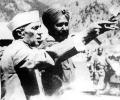
Let us hope that what happened in 1962 will never happened again, prays Claude Arpi
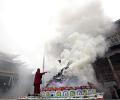
China has been keeping tabs on the restive Tibet province through a 'grid' system and some 600 'convenience police posts' armed with high-tech equipment that monitor the daily life of the citizens of Lhasa and other Tibetan towns. Worse, 'volunteer security groups' known as 'Red Armband Patrols' are roaming around in order to get more information and 'classify' each and every citizen, says Claude Arpi

Could some frustrated Chinese generals have decided to teach India a lesson to sink Xi Jinping's world dream, asks Claude Arpi.

India should take up the issue in the strongest way with Beijing. But the solution is definitively not building more dams in Arunachal Pradesh, cautions Claude Arpi.
The People's Daily, the Chinese Communist newspaper, says the sale of the Rafale fighter plane 'encourages, excites and spurs India's appetite and ambition to become a great military power.' Does India have a choice, considering the People's Liberation Army's frantic speed of development, wonders Claude Arpi.
'I know they can put a dagger in our back at any time... It is an experience which marked everybody's life... The fog of war was so thick that nobody could see anything,' remembers Brigadier Amarjit Singh Behl (retd), recounting his role in the 1962 Indo-China war.
After the defeat in the 1962 war with China, the Indian government requested Lieutenant General Henderson-Brooks and Brigadier Prem Bhagat to prepare a report. Fifty years later, it remains one of India's most secret documents. What on earth has stopped the government from revealing the report to the Indian public, asks Claude Arpi.

Sidney Wignall, a British mountaineer who spied on China for India in the 1950s, passed unnoticed into the ages this week.
A solid political relation with France could balance India's foreign relations, which have often tilted towards the United States or Russia, says Claude Arpi.
 © 2026 Rediff.com - Investor Information - Advertise with us - Disclaimer - Privacy Policy - Sitemap - Feedback - About us - Terms of use - Grievances